What Does a Safety Consultant Cost in Canada? (2026 Rate Guide)
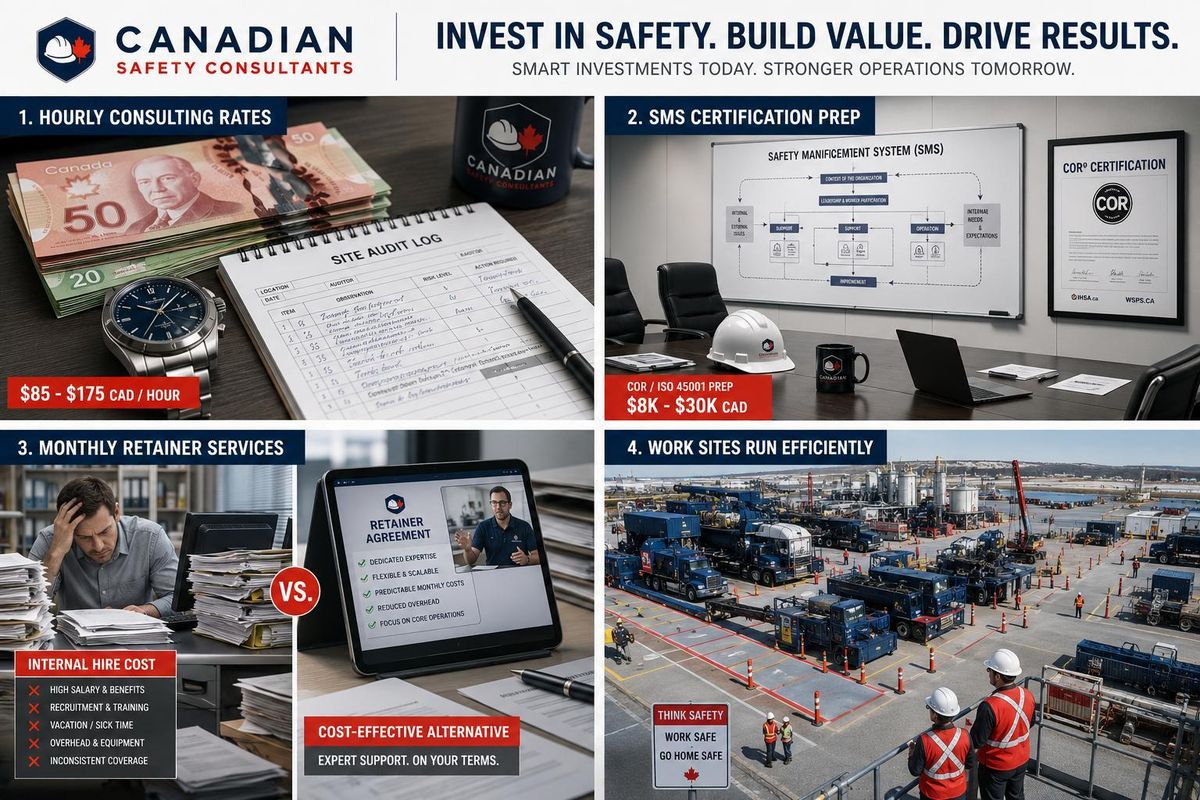
Canadian safety consultants charge $85–$175 per hour, or run defined projects like COR certification preparation in tiers — from a $2,500–$3,500 Readiness Assessment up to $14,000–$20,000 for Full Support. Monthly retainers for ongoing support run $1,500–$7,000. This guide breaks down what drives those numbers, what you actually get at each price point, and how to decide whether consulting makes financial sense — so you can budget accurately before picking up the phone.
A scoped, fixed-fee quote before work begins is the single most effective thing you can do to control your consulting spend. Always ask for one.
Hourly rates: what the market pays
Hourly billing is standard for audits, training delivery, incident investigations, and short-term advisory work. The rate depends primarily on credential level and industry specialization:
| Consultant profile | Typical hourly rate (CAD) | Best for |
|---|---|---|
| General safety consultant (no designation) | $65–$95/hr | Inspections, basic training, documentation review |
| CRSP-certified consultant | $100–$140/hr | Safety program development, audits, compliance work |
| CRSP + COR Lead Auditor | $120–$160/hr | COR certification, gap analysis, audit preparation |
| CRSP + ISO 45001 Lead Auditor | $130–$175/hr | ISO 45001 implementation, management system design |
| Specialized (process safety, industrial hygiene) | $150–$225/hr | HAZOP, PSM, complex industrial environments |
Travel time is billed at 50–100% of the standard rate. Out-of-province work adds $500–$1,500/day in travel and accommodation on top of consulting fees.
Project-based fees: what defined scopes cost
Most substantive consulting work is scoped and quoted as a flat project fee. You get cost certainty, and the consultant has no incentive to drag the work out. Typical ranges for common engagements:
| Project type | Typical range (CAD) | Key variables |
|---|---|---|
| COR Readiness Assessment (gap analysis + action plan) | $2,500–$3,500 | Number of sites, complexity of operations |
| COR Foundation Package (program docs + training coordination) | $7,500–$12,000 | Company size, existing program maturity |
| COR Full Support (+ audit prep + internal audit support) | $14,000–$20,000 | Company size, industry, program maturity |
| Safety program development (from scratch) | $10,000–$40,000 | Industry risk level, number of procedures needed |
| ISO 45001 implementation | $15,000–$50,000 | Existing management systems, scope of certification |
| Hazard assessment (full baseline) | $3,000–$12,000 | Number of tasks, site complexity |
| Incident investigation | $2,500–$8,000 | Incident severity, regulatory reporting required |
| Emergency response plan | $3,000–$10,000 | Number of scenarios, tabletop exercise included? |
| WHMIS/TDG training (per session) | $800–$2,500 | Group size, custom vs. off-the-shelf content |
Monthly retainers: what ongoing support costs
For businesses that need regular safety coverage without the cost of a full-time hire, a monthly retainer is the most common arrangement. Typical tiers:
| Retainer tier | Hours/month | Monthly cost (CAD) | What's typically covered |
|---|---|---|---|
| Light support | 8–12 hrs | $1,200–$2,000 | Policy review, regulatory updates, email/phone advisory |
| Standard support | 15–20 hrs | $2,000–$4,000 | Monthly inspections, incident review, training coordination |
| Full outsourced safety | 25–40 hrs | $4,000–$7,000 | Audits, training, JHSC support, regulatory liaison — acts as your safety department |
Consultant vs. full-time safety officer: the real numbers
We get this question constantly: "At what point does it make sense to just hire someone full-time?" Easier to answer than most employers think — the salary numbers are public.
A CRSP-certified full-time safety officer costs $75,000–$110,000 in base salary in Canada. Add 25–30% for benefits, vacation, and overhead and you're at $95,000–$140,000 per year all-in. A consultant on a standard retainer covering 20 hours a month costs $3,000–$4,000 a month, or $36,000–$48,000 per year. No benefits, no vacation liability, no recruitment costs when they leave.
The break-even point is roughly 30+ hours of dedicated safety work every week of the year. Most small and mid-size Canadian businesses — construction, manufacturing, oil and gas under 100 employees — aren't close to that threshold.
There's also the credential gap. Building a CRSP + COR Lead Auditor + ISO 45001 Lead Auditor stack in-house takes $15,000–$25,000 in training fees and years of audit hours. Hire it on retainer, and you're not paying to build it from scratch. You also don't lose it when the person resigns.
CRSP + COR Lead Auditor + ISO 45001 expertise on a retainer costs a fraction of what it costs to develop those designations in-house — and you don't lose it the day someone hands in their notice.
Senior-led delivery. Modern toolset. CRSP-certified expertise.
The person who pitches your engagement is the same person who does the work. No junior associate billing at senior rates behind a partner's name. CRSP Certified. COR & ISO 45001 Lead Auditors. 95% first-attempt COR audit success rate. We run on a modern documentation and research toolset that strips a lot of the labour hours national firms still pad into their quotes — so you get the same audit-ready output for fewer hours on the invoice. Fixed-fee, all provinces. No open-ended hourly billing.
Get a quote →What drives your quote up — or down
Factors that push costs higher
- Starting from scratch. A safety management system built from no existing documentation is 3–5x more work than improving one that's already partially in place.
- High-risk industry. Oil and gas, mining, and confined space environments need more specialized expertise and more on-site time than a warehouse or office environment.
- Multiple sites. Every additional location adds documentation hours, travel, and audit time to the scope.
- Tight timeline. COR prep in 6 months instead of 12–18 typically adds a 20–30% premium. Rush work costs more in any professional service.
- Regulatory investigation support. Ministry of Labour inspection responses and OHS proceedings require senior expertise and bill accordingly.
Ways to reduce cost without cutting quality
- Prepare before the engagement starts. Gather existing policies, training records, and incident history in advance. Every hour a consultant spends hunting for documents is billable time you're paying for.
- Assign an internal coordinator. One person who can gather information, schedule workers, and follow up on action items reduces consultant hours considerably — often by 20–30%.
- Define the deliverable, not just the topic. "COR gap analysis with written report and 90-day action plan" has a fixed scope. "Help with safety" doesn't. Fixed scope means fixed cost.
- Bundle training with consulting. Delivering WHMIS or working-at-heights training during an existing engagement avoids a separate mobilization cost.
- Commit to a multi-year retainer. A 12–24 month agreement typically earns a 10–15% discount on monthly rates.
- Hire a firm with a modern delivery model. Senior-led shops with strong documentation and research tooling can deliver in days what mid-size firms bill as multi-week engagements. Same credentials, same audit-ready output, far fewer hours on the invoice.
Red flags when evaluating quotes
Not all safety consulting proposals are built the same. A few things worth questioning before you sign:
- No credentials listed. Ask specifically for CRSP, COR auditor, or ISO 45001 auditor certification. "Safety experience" without a designation is a yellow flag for compliance-critical work.
- Hourly billing with no estimate. An open-ended engagement with no scoped estimate makes budgeting impossible. Any credible consultant can give you a range — push for one before agreeing to anything.
- Generic templates called "custom." A 450-page safety program that looks identical to every other client's won't survive a COR audit looking for site-specific documentation. Ask to see a sample from a similar-size company in your industry.
- No audit success data. For COR-specific work, ask for their first-attempt success rate. The industry average sits around 70–75%. Credentialed consultants who specialize in COR typically exceed 90%.
- Unfamiliarity with your registrar. COR is administered by different organizations in each province — IHSA in Ontario, ACSA in Alberta, BCCSA in BC. A consultant who doesn't know the difference will calibrate your program to the wrong standard.
- Senior pitches, junior delivers. At larger firms, the partner who sells the engagement often isn't the one doing the work. The actual writing and the on-site audit get handed to a junior associate. Worth asking outright before you sign: who is going to be writing my documentation and standing in the audit room? If it's not the senior consultant on the proposal, you're paying senior rates for junior output.
Does safety consulting pay for itself?
The ROI math is straightforward. A single lost-time injury in a Canadian workplace costs $38,000–$50,000 on average, per CCOHS estimates — direct and indirect costs combined. That's before any Ministry of Labour fines or legal exposure stack on top.
COR certification can reduce WSIB premiums by up to 10% in Ontario and makes you competitive for public and large private sector bids. In many industries, COR has stopped being optional and become a contract prerequisite. ISO 45001 is heading in the same direction with enterprise clients and government procurement; without it, you don't qualify for certain work.
A $12,000 COR project that prevents one lost-time injury pays for itself in year one. Factor in the WSIB premium savings and the new contract eligibility, and most organizations break even inside 24 months. We've had clients clear the full cost in WSIB savings alone before they'd owned the certificate 18 months.
A $12,000 COR certification project that prevents one lost-time injury pays for itself. The math isn't complicated — it just rarely gets done until after the fact.
Quick budget guide by company size
- 1–10 employees, low-risk industry: $3,000–$8,000/year (light retainer or annual program review)
- 10–50 employees, moderate risk (construction, manufacturing): $10,000–$25,000/year (standard retainer + COR maintenance)
- 50–200 employees, high risk (oil and gas, mining): $25,000–$60,000/year (full outsourced safety or senior retainer + training)
- COR certification project (one-time, add to year one): $2,500–$3,500 (Readiness Assessment) to $14,000–$20,000 (Full Support)
Frequently asked questions
How much does a safety consultant cost in Canada?
Canadian safety consultants charge $85–$175 per hour depending on credentials. CRSP-certified consultants with COR or ISO 45001 auditor designations are at the upper end. COR certification preparation is tiered — a $2,500–$3,500 Readiness Assessment, a $7,500–$12,000 Foundation Package, or $14,000–$20,000 Full Support. Monthly retainers for ongoing support are $1,500–$6,000/month.
Is it cheaper to hire a consultant or a full-time safety officer?
For most small and mid-size businesses, a consultant costs 2–3x less. A full-time CRSP-certified safety officer runs $95,000–$140,000/year all-in. A consultant retainer for equivalent coverage costs $36,000–$48,000/year — no benefits, vacation, or recruitment costs. The math favours consulting until you genuinely need 30+ hours of safety attention every week of the year.
What does COR certification consulting cost in Canada?
COR certification support is offered in tiers: a Readiness Assessment (gap analysis + priority action plan) at $2,500–$3,500, a Foundation Package (program documentation + training coordination) at $7,500–$12,000, and Full Support (adds audit preparation + internal audit support) at $14,000–$20,000 CAD. A COR annual maintenance retainer keeps certification current at $2,400–$4,800/yr. The investment typically pays back within 2 years through WSIB premium reductions and improved contract eligibility.
Are safety consultant fees tax deductible in Canada?
Yes. Safety consulting fees are a legitimate business expense, deductible against business income. For larger investments like a full safety management system build-out, consult your accountant on whether to expense or amortize — but the deductibility is not in question.
What should I ask a safety consultant before hiring?
Ask: (1) What certifications do you hold — CRSP, COR auditor, ISO 45001 auditor? (2) What is your first-attempt COR audit success rate? (3) Are you familiar with the registrar in my province — IHSA, ACSA, BCCSA? (4) Can you provide a fixed-fee project quote rather than open-ended hourly billing? (5) Can you provide references from companies of similar size in my industry?
Does HSE Advisor Canada offer fixed-fee quotes?
Yes. We provide project-based flat-fee quotes for COR certification, ISO 45001 implementation, safety program development, and other defined-scope engagements — so you know the total cost before work begins. Contact us for a no-obligation scoped quote.
Why is HSE Advisor's quote often more competitive than mid-size or national firms?
Two reasons. The senior CRSP-certified consultant who pitches your engagement is the same person doing the work — there's no junior associate getting billed at senior rates behind the scenes. And we run on a modern documentation and research toolset that strips a lot of the labour hours national firms still pad into their COR and program-build quotes. Same credentials (CRSP, COR Lead Auditor, ISO 45001 Lead Auditor), same audit-ready output, fewer hours on the invoice. We don't carry the overhead of a national-firm office network, so the savings flow to the client instead of the partner pool.
Sources