Tick Bite Prevention for Canadian Outdoor Workers: A Field Guide for Employers
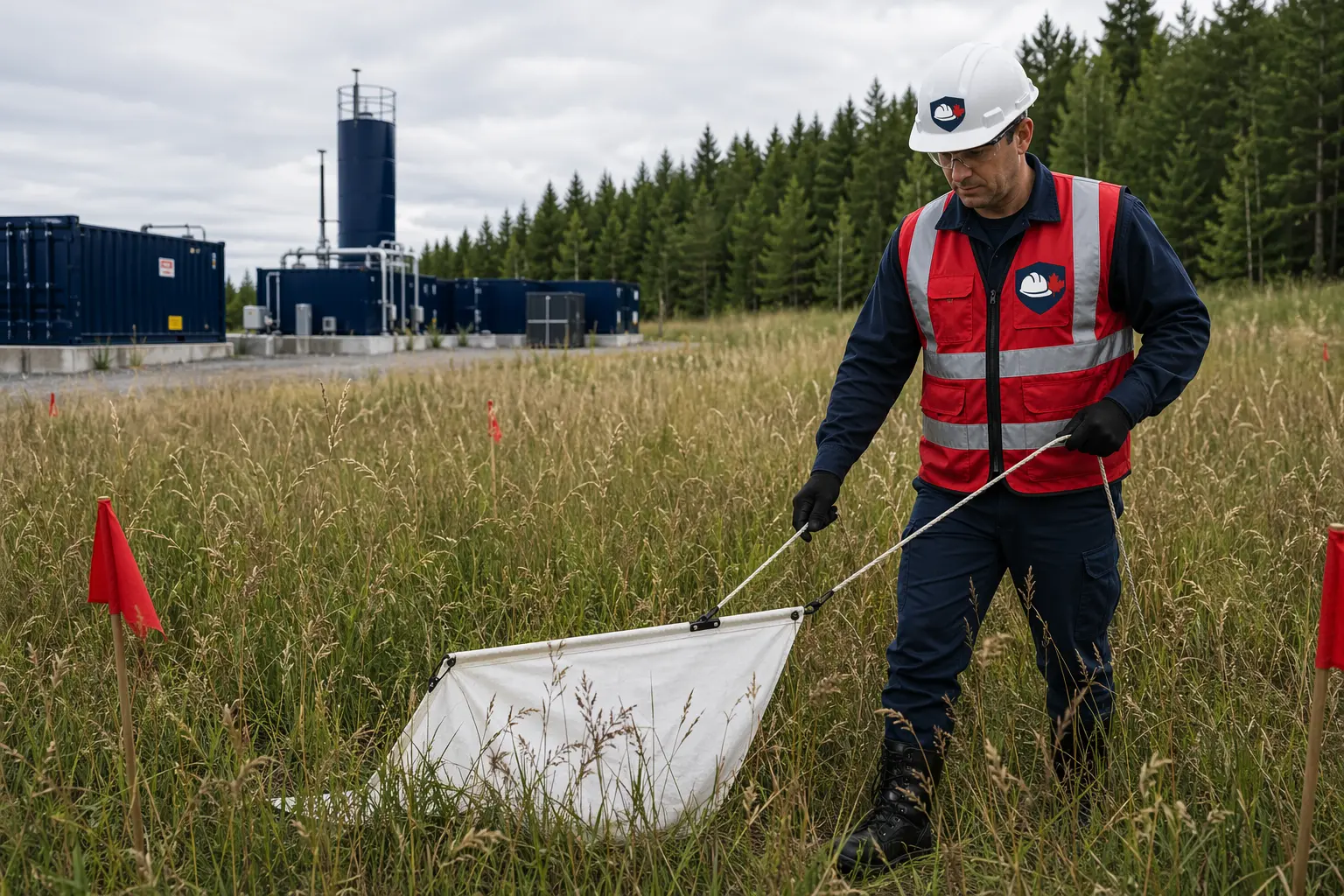
Reported Lyme disease cases in Canada climbed from 144 in 2009 to over 3,000 in 2022, according to the Public Health Agency of Canada. Public health researchers consistently agree that the real number is significantly higher because mild cases go undiagnosed and unreported. The cause of the climb is straightforward: black-legged tick populations are now established across most of southern Ontario, southern Quebec, the Maritimes, parts of southern Manitoba, and BC's Lower Mainland. The 1990s map of tick risk areas no longer reflects where Canadian crews are working.
Most outdoor employers we audit still do not have tick exposure listed in their hazard assessment. The crew lead has heard of Lyme. Sometimes the safety binder mentions ticks in passing under "biological hazards." Almost nobody has a documented procedure for bite response or end-of-shift checks.
Reported Lyme disease cases in Canada climbed from 144 in 2009 to over 3,000 in 2022. Public health researchers agree the real number is higher because mild cases go undiagnosed.
Why ticks belong in your hazard assessment
Every provincial OHS act in Canada includes a general duty clause requiring the employer to identify workplace hazards and take reasonable precautions to protect workers. Ticks fit cleanly inside that duty. They are biological hazards in the same regulatory category as bloodborne pathogens, mould, and animal bites. For any crew working in or near tall grass, brush, leaf litter, or wooded edges in regions with established or expanding tick populations, the obligation is real.
Specific obligations vary by province. In Ontario, Section 25(2)(h) of the Occupational Health and Safety Act requires the employer to "take every precaution reasonable in the circumstances for the protection of a worker." In Alberta, Part 35 of the OHS Code addresses biological hazards directly. BC's Occupational Health and Safety Regulation covers biological agents under Part 6. The federal Canada Labour Code Part II applies to federally regulated employers and includes parallel duties.
The gap we see in audits is not the duty itself — it is documentation. An inspector reviewing a Lyme disease workers' compensation claim will look first at the hazard assessment for the work area, then at the worker's training record, then at PPE issued, and then at incident reporting. If any of those four are missing or generic, the employer's position becomes harder. We have seen claims hinge on whether or not "ticks" appears as a named hazard in the pre-work assessment. They often don't.
Worker compensation outcomes for Lyme disease are also worth understanding. Lyme is a presumptive occupational disease in some provinces for workers in defined high-exposure roles. Where it isn't presumptive, the worker has to demonstrate that exposure occurred at work, which often comes down to whether the employer documented the hazard and the worker's exposure to it. Documentation that exists before an incident is worth significantly more than documentation written after one.
Which ticks matter for Canadian workers
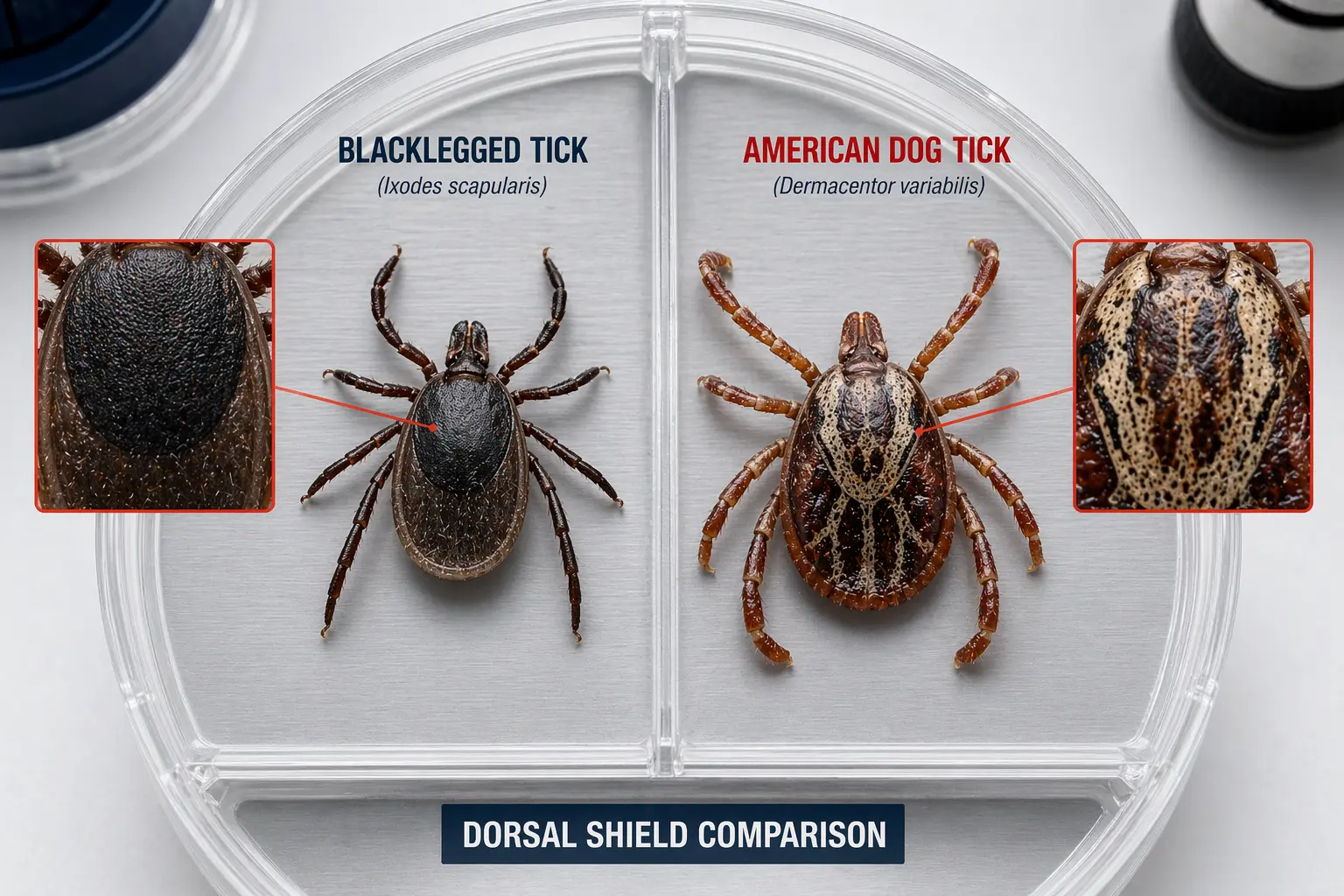
Not every tick a worker finds on their boot is a Lyme disease vector. A handful of species account for almost all of the workplace biological risk, and identification is genuinely useful both for response and for the conversation with the worker afterward.
Black-legged tick (Ixodes scapularis) is the species that matters most in eastern and central Canada. This is the primary vector for Lyme disease, anaplasmosis, babesiosis, and Powassan virus. Adults are dark brown to black, about the size of a sesame seed when unfed. Nymphs — responsible for most human bites because they are easy to miss — are roughly the size of a poppy seed. Established populations now cover southern Ontario, southern Quebec, the Maritimes, and parts of southern Manitoba. New risk areas appear annually as climate conditions shift.
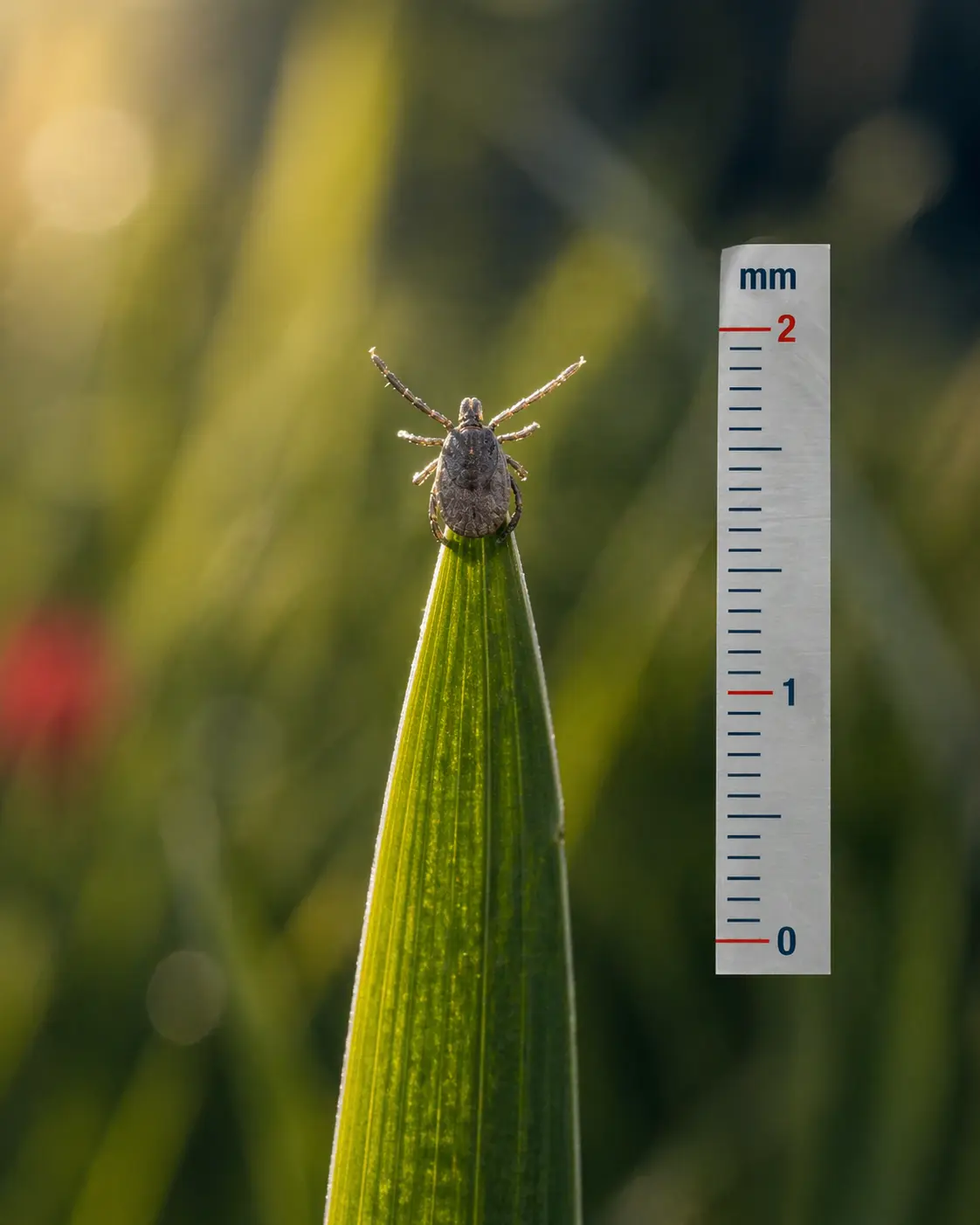
Western black-legged tick (Ixodes pacificus) is BC's primary Lyme vector. Range covers most of southern BC, including the Lower Mainland, southern Vancouver Island, and the Okanagan. Behaviourally and visually similar to the eastern species.
American dog tick (Dermacentor variabilis) is the larger tick most workers will recognize from past experience. Adults are about the size of an apple seed, brown with white or grey markings on the back. Common across Saskatchewan, Manitoba, Ontario, and the Atlantic provinces. Dog ticks do not transmit Lyme disease in Canada. They can transmit Rocky Mountain spotted fever in rare cases, and their bite still requires standard wound care, but they are not the species that should drive your tick prevention program.
Lone star tick (Amblyomma americanum) is uncommon in Canada but has been documented in southern Ontario in increasing numbers. It does not transmit Lyme disease, but it can transmit several other pathogens and has been associated with alpha-gal syndrome, a delayed allergy to red meat. Worth knowing about if your crews work in southern Ontario, but not the primary concern.
The tick range map you remember is out of date
The Public Health Agency of Canada updates risk area maps annually based on active surveillance and passive submissions. If your hazard assessment for outdoor work cites a range map from before 2020, it almost certainly understates current risk. Established populations are now confirmed in areas of Manitoba, BC, and northern Ontario that were considered low-risk a decade ago. Update your hazard documentation against the current PHAC surveillance map at the start of each season.
How tick exposure happens on a job site
Ticks do not jump, fly, or drop from trees. They climb to the tip of a blade of grass or a leaf, extend their forelegs, and wait for a warm-blooded animal to brush past. This behaviour is called questing. The practical consequence: the highest-risk surfaces on a job site are tall grass, leaf litter, brush, the edges of clearings against woodland, and riparian vegetation along ditches and waterways.
The crews most exposed in our audits are the ones whose work routinely puts them shin-deep or higher in vegetation. Surveyors and locators walking lines through long grass. Road maintenance and right-of-way crews. Hydro and telecom workers accessing rural infrastructure. Forestry and silviculture. Landscape construction. Land remediation crews. Utility crews clearing brush from substations. Custom harvesters. Research field crews working in established habitat zones.
The crews that are easy to miss are the ones whose work is mostly indoor or on improved surfaces but includes brief exposures: the electrician who walks through long grass to reach a meter, the property inspector visiting rural sites, the courier whose route includes a few semi-rural stops with overgrown edges. Brief exposure is still exposure. A nymph attached during a five-minute walk-through can stay attached unnoticed for 36 hours.
Indoor risk also matters more than most safety programs acknowledge. Ticks brought home on clothing, equipment, or pets can attach hours after the worker has left the site. The exposure record shows the worker indoors when symptoms developed, but the bite happened on the job. This is one reason a documented end-of-shift tick check matters — it establishes both that the worker did the check and that the exposure window closes at the work site.
The 24-hour rule and what to watch for after a bite
A black-legged tick generally needs to be attached for 24 to 36 hours before Borrelia burgdorferi — the bacterium that causes Lyme disease — is likely to transmit. This window is the single most actionable fact in tick bite prevention. It means an end-of-shift tick check, done properly, is more effective than any single piece of PPE you can hand out. Catch a tick within the first day and the Lyme transmission risk drops dramatically.
Other pathogens do not follow the same rule. Anaplasmosis can transmit in under 12 hours. Powassan virus has been documented to transmit in as little as 15 minutes. The 24-hour window applies specifically to Lyme. The takeaway is not to relax other controls — it is to understand that prompt removal helps with Lyme but is not a complete defence against everything a tick can carry.
An end-of-shift tick check, done properly, is more effective than any single piece of PPE you can hand out. The Lyme transmission window is roughly 24 to 36 hours.
Symptoms after a bite typically appear 3 to 30 days later. Lyme disease classically presents with an erythema migrans rash — an expanding red ring, sometimes with a clear centre (the bullseye), sometimes uniformly red. The rash appears in roughly 70 to 80 percent of infected people, which means up to 30 percent of cases never produce a visible rash. Other early symptoms include fever, chills, fatigue, headache, muscle aches, and joint pain. A worker presenting with what looks like summer flu after recent outdoor work should not be told to rest and rehydrate. They should see a physician and mention the possible tick exposure.
If the bite is found, document it. Note the date, the location on the body, and the work site. If the tick is still attached, remove it as described below and save it. Bishop's University runs eTick.ca, a public tick identification platform that accepts photographs and (in some provinces) physical specimens. Several provinces also accept ticks for testing through public health labs. A confirmed black-legged tick from a confirmed exposure date strengthens any subsequent claim significantly.
Engineering and administrative controls that work
The hierarchy of controls applies to ticks the same way it applies to anything else. Modify the environment first, then change how the work happens, then put PPE on the worker.
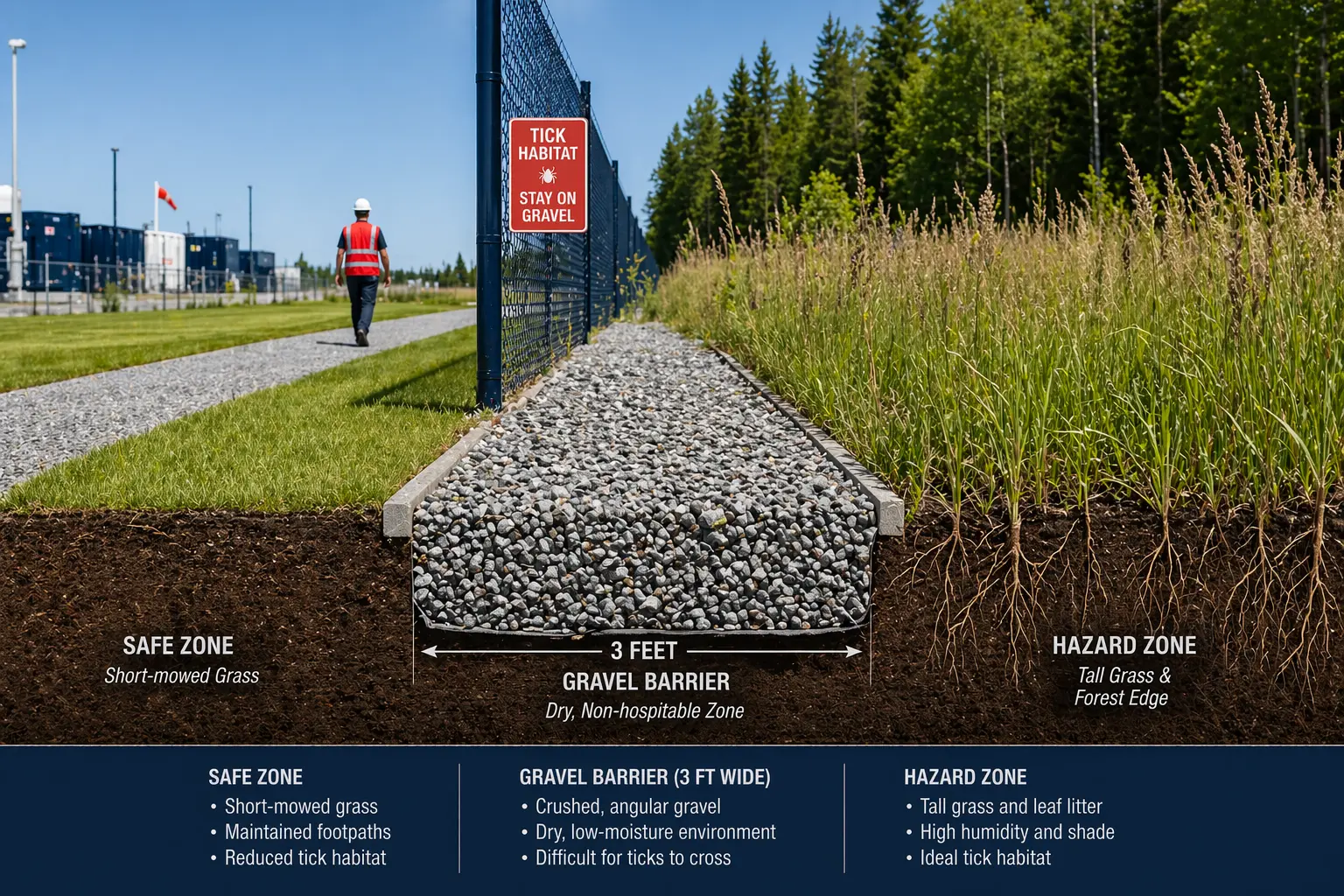
Engineering — modify the site. Where the work area is fixed and you control the ground conditions, keep grass short. Ticks dehydrate quickly in dry, exposed conditions, and short grass with full sun has dramatically lower tick density than long grass or leaf litter. Where the work zone borders a wooded edge, a buffer strip of gravel, woodchip mulch, or paved surface at least one metre wide reduces tick crossover. This applies to fixed work yards, training pads, lay-down areas, switching stations, and any rural permanent location with worker presence.
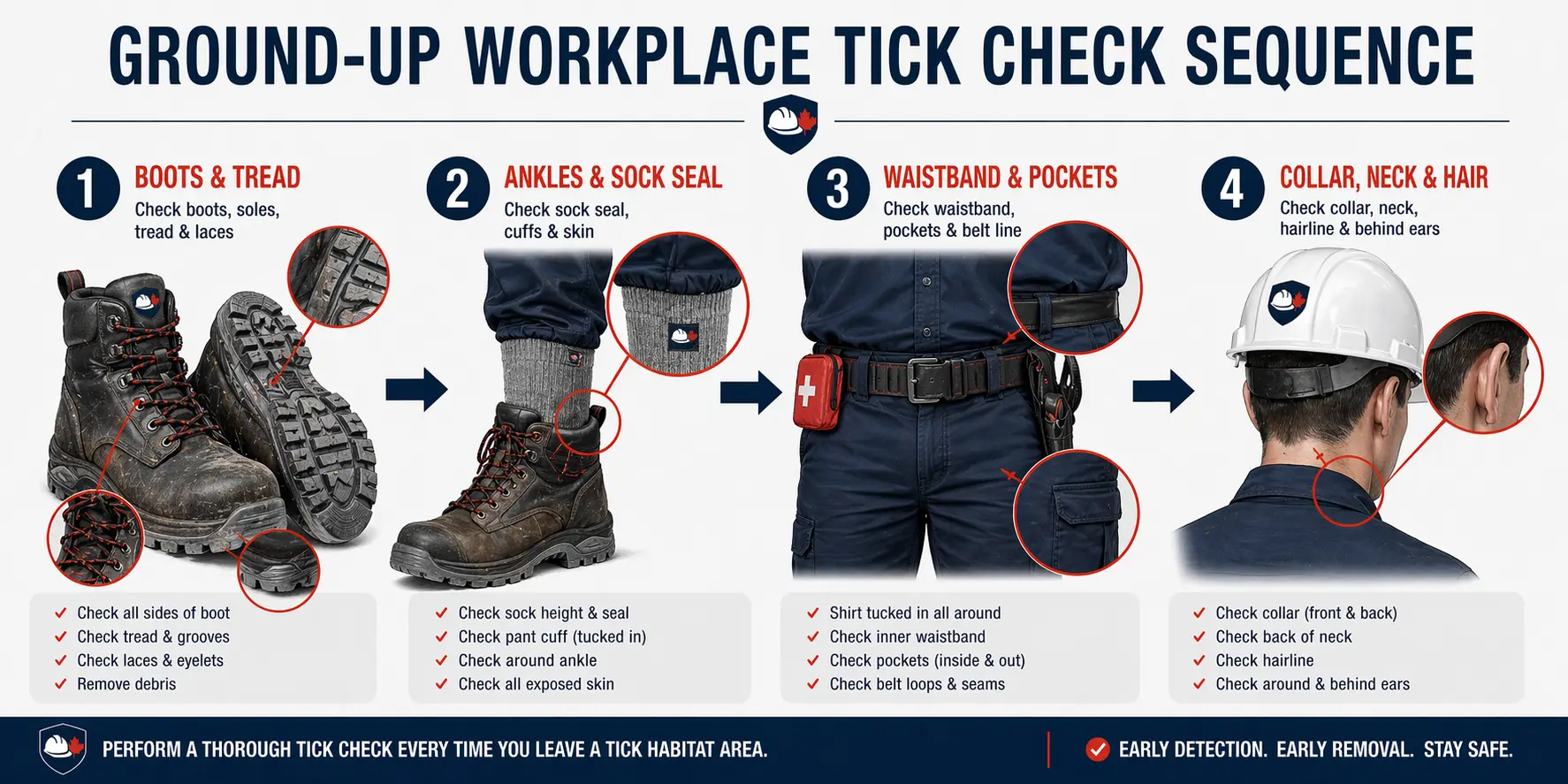
Administrative — change how the work happens. Pre-work hazard assessments need to name tick exposure as a hazard for any outdoor work in tick range areas. Daily end-of-shift tick checks need to be a documented step, not an informal habit. Buddy checks for hard-to-see areas — back, scalp, behind ears, behind knees, groin, waistband — should be normalized as part of the procedure rather than treated as awkward. Documented training before the season starts protects both the worker and the employer. A short toolbox talk with photographs of identification features and a demonstration of removal technique is better than a binder no one reads.
Tick Awareness Training
Our online Tick Awareness course covers identification, exposure controls, the 24-hour rule, removal technique, and bite response — built specifically for Canadian outdoor crews. Completion satisfies the documented training requirement under provincial OHS biological hazard duties.
View Tick Awareness Course →PPE that holds up in the field
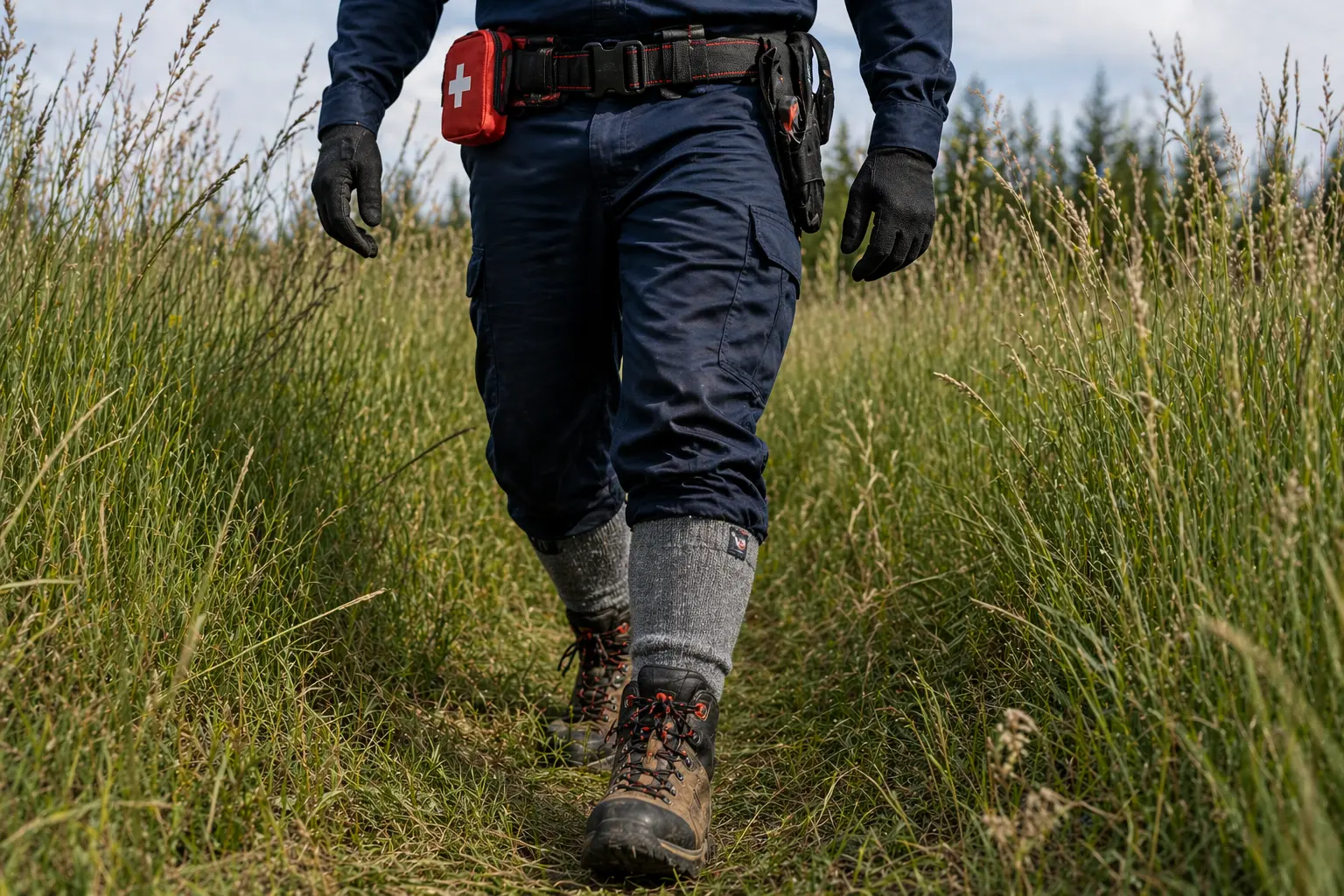
Ticks defeat fashion. Workers who tuck their pants into their socks look ridiculous and they know it. The point of the practice is that a tick climbing a pant leg has nowhere to disappear into — it stays on the outside of the fabric where a buddy check will find it. The same logic applies to tucking a shirt into the waistband. The visible-perimeter principle is not optional once you understand what it does.
PPE for tick-risk outdoor work
- Light-coloured clothing — ticks show clearly against khaki, light grey, or beige fabric. Dark clothing makes visual checks much harder.
- Long pants tucked into socks or boot tops — full coverage from ankle up. Yes, it looks awkward. Yes, it works.
- Long sleeves tucked into gloves where appropriate — for brush clearing, surveying in dense vegetation, or any work where forearms contact growth.
- Permethrin-treated clothing for higher-exposure work. Permethrin is an insecticide bonded to fabric — it kills ticks on contact, not just repels them. One spray application lasts roughly 6 wash cycles. Factory pre-treated garments retain effectiveness for around 70 washes.
- DEET (20 to 30 percent) or Icaridin (20 percent) on exposed skin. Both are Health Canada approved. Icaridin is non-greasy and does not damage plastics, which matters for crews handling synthetic gear.
- Boots, not running shoes, for any work in vegetation. Closed footwear with covered ankles is non-negotiable.
- Visual inspection at end of shift — clothing, gear, exposed skin, and a buddy check for areas the worker cannot see.
What does not work: cloth gardening gloves (ticks cling to fabric weave and transfer during removal), bug-repellent wristbands (no evidence of effectiveness against ticks), and the assumption that "I'd feel it if one was on me." Nymph-stage black-legged ticks are roughly the size of a poppy seed. Workers do not feel them. The bite itself is painless. The only reliable detection is a visual check.
Never burn, smother, or crush an attached tick
Old removal methods — applying a match, smothering with petroleum jelly, painting with nail polish, or crushing the body with bare fingers — all increase the risk of pathogen transmission. A stressed tick regurgitates stomach contents into the bite wound. Pathogens that were sitting in the tick's gut now enter the host. The current evidence-based method is mechanical removal with fine-tipped tweezers as close to the skin surface as possible, with steady upward pressure and no twisting. Wash the bite site with soap and water afterward. Apply antiseptic. Save the tick in a sealed bag with a damp cotton ball for identification or testing.
Field tips from three decades of outdoor work
A few practices that are not in most manuals but consistently come up from field-experienced supervisors:
Lint roller in the truck cab. A standard sticky lint roller, run over clothing and gear before getting in the vehicle at end of shift, picks up unattached ticks that are too small to spot visually. The roller stays in the truck. The crew uses it without thinking about it. This single low-cost intervention has prevented more bites than most engineering controls we have audited.
Dryer on high heat for 10 minutes. Ticks are surprisingly resistant to laundering — a wash cycle alone often does not kill them. Dry heat does. Field clothing that cannot be washed daily can still go through a 10-minute high-heat dryer cycle to kill any unattached ticks before the next shift.
Tick removal kit at every first aid station. Fine-tipped tweezers (not the broad-tip drugstore kind), antiseptic wipes, a small zip-top specimen bag with a damp cotton ball to keep the tick alive for testing, and a printed identification card with photographs of the species relevant to your region. Total cost under $20. This costs nothing on a budget line and converts an awkward field improvisation into a routine procedure.
Fine-tipped tweezers as close to the skin as possible. Steady upward pressure. No twisting. Wash the bite site. Save the tick. Document the date.
Document the find, even if no bite occurred. A tick removed from clothing before attachment is still useful information. It tells you ticks are present in that work area on that date. Over a season, those data points show whether your hazard assessment is still accurate or whether the population has shifted.
Submit the specimen. Bishop's University operates eTick.ca, a national tick identification service that accepts photo submissions. Several provincial public health labs accept physical specimens for pathogen testing — Manitoba, Quebec, Nova Scotia, and New Brunswick all have programs at the time of writing. Confirmed identification of a vector species at a specific work site, on a specific date, is the strongest documentation of exposure available.
Building tick awareness into your seasonal safety program
Ticks are active any time temperatures exceed roughly 4°C, which in much of populated Canada means peak season runs April through October but exposure can occur in any month with thawed ground. The employers who handle this well treat tick awareness as a seasonal program element on the same footing as heat stress in summer or cold exposure in winter.
The practical structure that works:
A pre-season toolbox talk before the first outdoor shift in tick range. Identification photos of the species relevant to your region. A demonstration of correct removal technique. The end-of-shift check procedure walked through with the crew. A sign-off sheet. Total time: under 30 minutes per crew.
A site-specific hazard assessment that names tick exposure where applicable. Updated when work moves to a new area. Photographed where possible.
Tick check verification as a documented step in end-of-shift sign-off for tick-risk work. Not a separate form — a line item in the existing daily report.
Tick exposure included as a reportable event in your incident reporting system. Bites get logged, even if no symptoms develop. This protects the worker's claim months later if symptoms appear and matters for your safety program trend data.
An annual review of the Public Health Agency of Canada tick surveillance data and a corresponding refresh of your hazard assessment if range has shifted into your work area. Five minutes of a safety coordinator's time, once a year, to keep the documentation current.
Sources
- Public Health Agency of Canada — Surveillance of Lyme Disease in Canada
- Public Health Agency of Canada — Risk of Lyme Disease to Canadians
- CCOHS — Lyme Disease and Tick-Borne Illness
- Health Canada — Safe Use of Insect Repellents
- eTick.ca — Public Tick Identification Platform (Bishop's University)
- Ontario Occupational Health and Safety Act, RSO 1990, c O.1, s. 25(2)(h)
- Alberta OHS Code, Part 35 — Health Care and Industries with Biological Hazards