Back-to-School Road Safety: The September Hazards Every Canadian Driver Needs to Know

Toronto's Transportation Services department has put it bluntly: expect a 20 to 30 percent jump in collisions in the city once school is back, tied to roughly 15 to 20 percent more traffic on residential streets during drop-off and pickup windows. That's one city's numbers, not a national count, but the pattern behind it isn't local. Parachute Canada's injury data backs it up from the pedestrian side, and this one is Canada-wide. Children are more likely to be hit by a vehicle in September, October, and November than in any other stretch of the year, and most of those collisions happen between 3 and 7 p.m., right when school lets out and commuter traffic overlaps with kids walking home.
If you manage a fleet, run a crew that drives residential routes, or just get behind the wheel on a school day, September asks more of you than August did. Here's what actually changes on the road this month, and what to do about it before the routines get worse instead of better.
Children are more likely to be hit by a vehicle in September, October, and November than in any other stretch of the year, and most of those collisions happen between 3 and 7 p.m.
Why September is the riskiest month for kids on the road
Part of the problem is pure volume. Ten weeks without school buses, crossing guards, or clusters of kids at intersections lets driving habits go slack. Then, almost overnight, thousands of school zones across the country are active again, and a lot of drivers are still running on July muscle memory. A 2019 CAA poll found 70 percent of Canadians had personally witnessed speeding in a school zone. Not heard about it. Witnessed it. That number hasn't improved much; CAA's 2025 survey of Ontario parents found 81 percent report traffic buildup at drop-off and 84 percent at pickup, both up from the year before.
On average, roughly 1,014 Canadian children are injured as pedestrians every year, and in 2024, 15 children under 14 were killed in pedestrian incidents. Those numbers aren't evenly spread across the calendar. They cluster hard in the fall, and September is where the clustering starts.
In the driver safety assessments we run for clients with delivery or service routes, September is the month we flag hardest for refreshers. Not because the roads changed. Because the drivers did.
What actually changes in a school zone, and why drivers miss it
The speed limit is the part most drivers get wrong, mostly because it isn't one number. Ontario municipalities can set school zone limits between 30 and 40 km/h by bylaw, and the exact figure depends on the sign, not on what you remember from last June. British Columbia runs a flat 30 km/h in posted school zones between 8 a.m. and 5 p.m. on school days. Alberta leans on playground zones instead, with 30 km/h in effect every single day from 8:30 a.m. until an hour after sunset, school in session or not. Three provinces, three different rules, and the only way to know which one applies on your route is to read the sign in front of you.
Then there's the congestion itself. Nearly nine in ten Ontario parents now report backups at pickup, which means more vehicles idling, more three-point turns in front of the school, and more kids darting between parked cars where a driver's sightline is worst. A crossing guard holding a stop sign doesn't fix any of that alone. They manage one crosswalk, not the chaos on either side of it.
The school bus stop-arm law drivers still get wrong
Here's the rule in plain language: when a school bus activates its overhead red lights and extends its stop arm, every vehicle approaching from either direction must stop and stay stopped until the lights go off or the bus moves. In most provinces that applies to both directions of traffic, with one common exception. If the road is physically divided by a median, traffic on the far side isn't required to stop.
Ontario treats this seriously. Under section 175 of the Highway Traffic Act, failing to stop for a school bus's flashing red lights carries a fine of $400 to $2,000 and six demerit points on a first offence, more than most speeding tickets carry. (A pending amendment will extend the legal trigger to the extended stop arm itself, not just the lights, closing a gap in how the current law is written.) British Columbia's version, under section 149 of the Motor Vehicle Act, sets the fine at $368 with three demerit points, and requires drivers to stay at least five metres back until the lights stop flashing. Every province enforces some version of this rule; confirm the fine and demerit point figures where you drive before assuming Ontario's or BC's numbers apply.
In Ontario, failing to stop for a school bus's flashing red lights carries a fine of $400 to $2,000 and six demerit points, more than most speeding tickets.
When you must stop for a school bus
- Overhead red lights flashing, stop arm extended: stop before you reach the bus, from either direction.
- Stay stopped until the lights stop flashing or the bus starts moving again. Not before.
- On a road with a physical median dividing traffic, only your side needs to stop. Check for a raised or marked median, not just a centre line.
- Never pass on the right, even if kids appear to be clear of the road. Children re-cross unpredictably.
- A stopped school bus at a residential intersection is not a passing opportunity. Treat every stop-arm activation as a full, unhurried stop.
Why school buses stop at every railway crossing
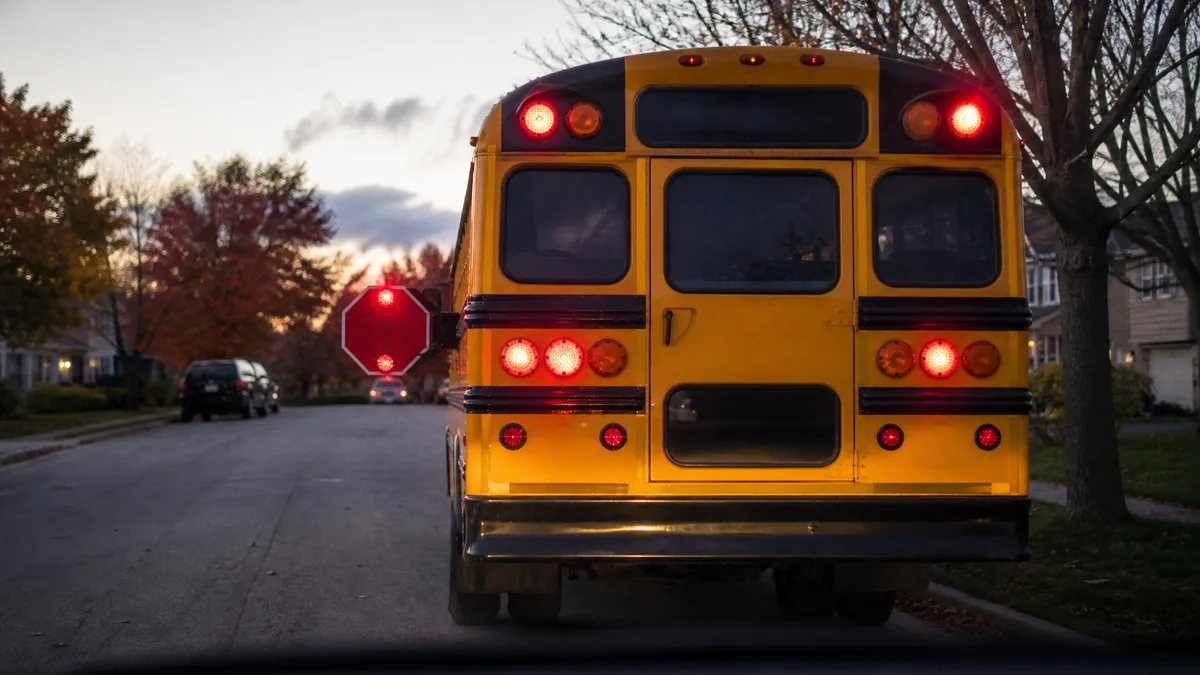
If you've ever been stuck behind a school bus that stopped, opened its door, and sat motionless at a railway crossing with no train in sight, you've seen a rule with a real, grim origin. A 1938 level-crossing disaster in the United States, a school bus struck by a train with 23 students killed, pushed American transportation authorities to require every school bus, loaded or empty, to stop at every crossing, open the door, and physically look and listen before proceeding. Canadian provinces wrote their own versions of the same stop-look-listen requirement into provincial highway traffic acts over the decades that followed. Ontario's current rule, for instance, dates to a 1997 amendment.
The specifics vary slightly by province, but the pattern holds everywhere. Manitoba's regulation requires the driver to stop between 5 and 15 metres from the nearest rail, open the service door, and check both directions before moving. Ontario requires a stop at any crossing protected by gates or signal lights, even when those lights aren't currently active. Saskatchewan requires a stop unless the crossing has automatic light signals confirming it's clear.
For the driver behind that bus, the takeaway is simple: expect it. A school bus stopping cold at a crossing with no visible train is not a malfunction, and following too close behind one through September and October, when new routes and new drivers are still working out their timing, is asking for a rear-end collision you'll have a hard time explaining.
Defensive Driving
Our online Defensive Driving course covers hazard perception, following distance, and school-zone-specific scenarios. Built for employers who need documented training for anyone driving a company vehicle on residential or school routes.
View Defensive Driving Course →Losing the light: glare, dusk commutes, and the slide toward daylight saving time
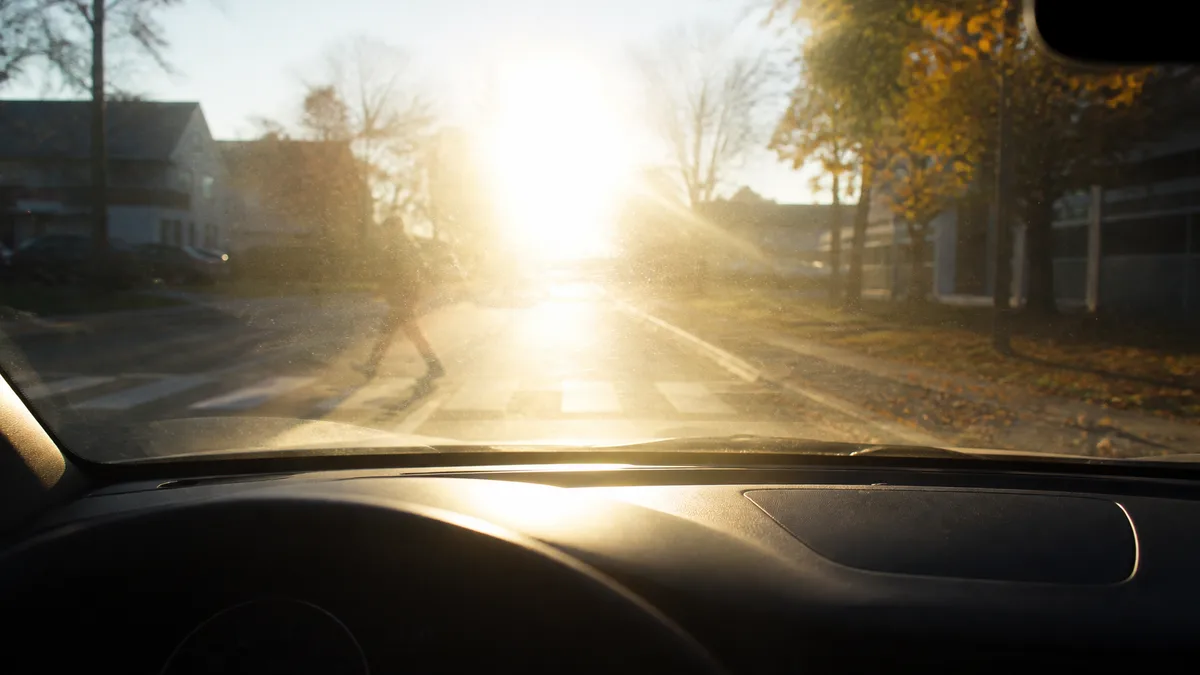
Nobody briefs drivers on this one, and it's arguably the hazard that builds the most quietly. Daylight shrinks by roughly three minutes a day through September at mid-latitudes in Canada, which means the sun sits lower in the sky during both the morning drop-off run and the afternoon pickup run than it did in August. A low morning sun sitting almost level with the windshield can wash out a crosswalk, a crossing guard's vest, or a kid stepping off a curb for a second or two. Exactly the second or two that matters.
The afternoon side of this is worse, and it gets worse as fall goes on. Parachute Canada's data puts the highest child pedestrian injury window at 3 to 7 p.m. As September turns into October, that window increasingly overlaps with dusk instead of daylight. Then, on November 1, 2026, clocks fall back an hour (2 a.m. becomes 1 a.m.), and the sunset that used to happen at 6:30 p.m. suddenly happens at 5:30 p.m. The high-injury commute window doesn't move. The daylight covering it does.
The DST convergence
Most of Canada falls back to standard time on November 1, 2026. Saskatchewan is the exception. It stays on Central Standard Time year-round and never changes its clocks. Everywhere else, the practical effect is the same: the after-school window that already carries the highest child pedestrian injury risk shifts from daylight into dusk almost overnight. If your team drives residential routes in the late afternoon, this is worth flagging before the clocks change, not after.
We'd rather see this addressed proactively than reactively. A driver who hasn't been told to expect the glare, or expect the earlier dusk, adjusts their habits a week too late.
Building a September driver safety briefing for your team
None of this requires a new safety program. It requires fifteen minutes and a checklist, ideally before the first week of school, and again as DST approaches in late October.
September toolbox talk checklist
- Confirm the posted school zone speed limit on every regular route. Don't assume it's the same as last year.
- Walk through the stop-arm law and the actual fine and demerit point consequences for your province.
- Cover school bus behaviour at railway crossings so a sudden full stop doesn't surprise anyone.
- Adjust for glare: sun visors positioned correctly, sunglasses in the vehicle, longer following distance during low-sun hours.
- Flag the 3-to-7-p.m. window as higher risk for any route passing a school, and flag it again as dusk creeps earlier through October.
- Ask drivers to report near-misses in school zones, not just collisions. A near-miss log tells you where to focus before something worse happens.
None of this requires a new safety program. It requires fifteen minutes and a checklist, before the first week of school and again as the clocks change.
We build a version of this into September safety meetings for clients running residential delivery or service routes. It isn't a new program bolted onto the existing one. It's the same toolbox talk format, pointed at a seasonal hazard that's easy to miss until it isn't.
Sources
- Global News — Police urge students to learn about road safety ahead of school year (Toronto Transportation Services collision and traffic volume figures)
- Parachute Canada — Pedestrian Safety
- Wikipedia — 1938 South Jordan train-bus collision
- CAA National — School Zone Safety
- Insurance-Canada.ca — CAA Congestion in School Zones Sparks Safety Concerns Among Parents
- Ontario Highway Traffic Act, RSO 1990, c H.8, s. 175 — Stopping School Buses (the Law)
- British Columbia Motor Vehicle Act, RSBC 1996, c 318, s. 149 — Stopping for a School Bus
- SGI Saskatchewan — Railway Crossings (Pro Driver Knowledge Base)
- timeanddate.com — Daylight Saving Time Changes 2026 in Canada