Snow and Ice Operations: The Hazards Your Winter Safety Program Misses

Most snow and ice injuries don't happen during the storm. WCB Nova Scotia analyzed nearly 1,700 claims from three winters and found they usually spike one to three days afterward, once the plows have left and everyone assumes the lot is fine.
If you own the winter program at a plant, warehouse or commercial property, that changes when you inspect and who you schedule. It also points at what the program probably skips: roofs, loaders in the lot, temporary heat, and the contractor you hired to handle all of it.
The storm is the part everyone plans for. The injuries show up on day two.
When do snow and ice injuries actually happen?
One to three days after a major weather event. That is the pattern WCB Nova Scotia found across nearly 1,700 snow and ice claims from the last three winters, and two-thirds of those winter injuries were slips, trips and falls, most often on outdoor surfaces like icy sidewalks and unshovelled walkways.
The numbers are not small. Through January 30 last winter, WCB had 278 snow and ice claims, against 197 at the same point the winter before and 217 two winters earlier. Over the three winters, 121 people reported broken bones and 58 had head injuries, including concussions. WCB counts every claim, including minor ones that cost no time away from work, so these figures tell you how often people go down, not only how badly they were hurt.
WCB ties the timing to people returning to icy lots and unshovelled walkways, and to the snow-clearing work itself. Its advice for the first three days is blunt: surfaces that look clear can still be icy, especially in shade and early in the morning.
This is one province's data, so we would not call it a national constant. But the mechanism does not depend on the postal code. A storm ends, the contractor leaves, meltwater refreezes overnight, and the building fills up with people who walk in from a lot that looks fine. If you want to know whether your own site follows the pattern, pull last winter's first-aid log, mark the storm dates, and see where the entries fall.
A 72-hour routine after every storm
- Walk the entrances, dock doors, smoking shelters and parking lot walkways before the first shift, not after the first complaint.
- Re-treat shaded spots, ramps and building corners again before the first and last shifts of day two and day three.
- Write down who inspected, when, and what was treated. You will want that record later (see the contractor section below).
- Decide before the storm who covers the slower start. WCB suggests flexible schedules when conditions are hazardous.
- Tell workers to wear winter boots or ice cleats with good traction, and keep a supply on site.
This is the same discipline a working safety program needs everywhere: a named person, a trigger, and a record. Our Slips, Trips, and Falls Prevention Awareness course covers the worker side of it.
What makes roof snow removal so dangerous?
Snow hides the things that won't hold a person. On January 26, 2022, a Saskatchewan worker clearing snow off the roof of a staging building stepped onto a fibreglass skylight buried under it. The skylight ruptured, and the worker fell to the floor below and died.
Saskatchewan's fatality report lays out the setup plainly. The employer assigned two workers to clear the buildup. The snow concealed several skylights. Neither worker had fall protection training, neither used a fall protection system, and the eave stood 4.6 metres off the ground. Visibility was poor that evening.
In May 2024 the employer pleaded guilty under section 9-2(2) of Saskatchewan's Occupational Health and Safety Regulations, 2020, which requires fall protection where a worker may fall three metres or more, or where a shorter fall could cause injury. The court imposed fines of $232,142.86 plus a $92,857.14 surcharge, $325,000 in total, covering that charge and a separate head-protection charge from a 2021 incident.
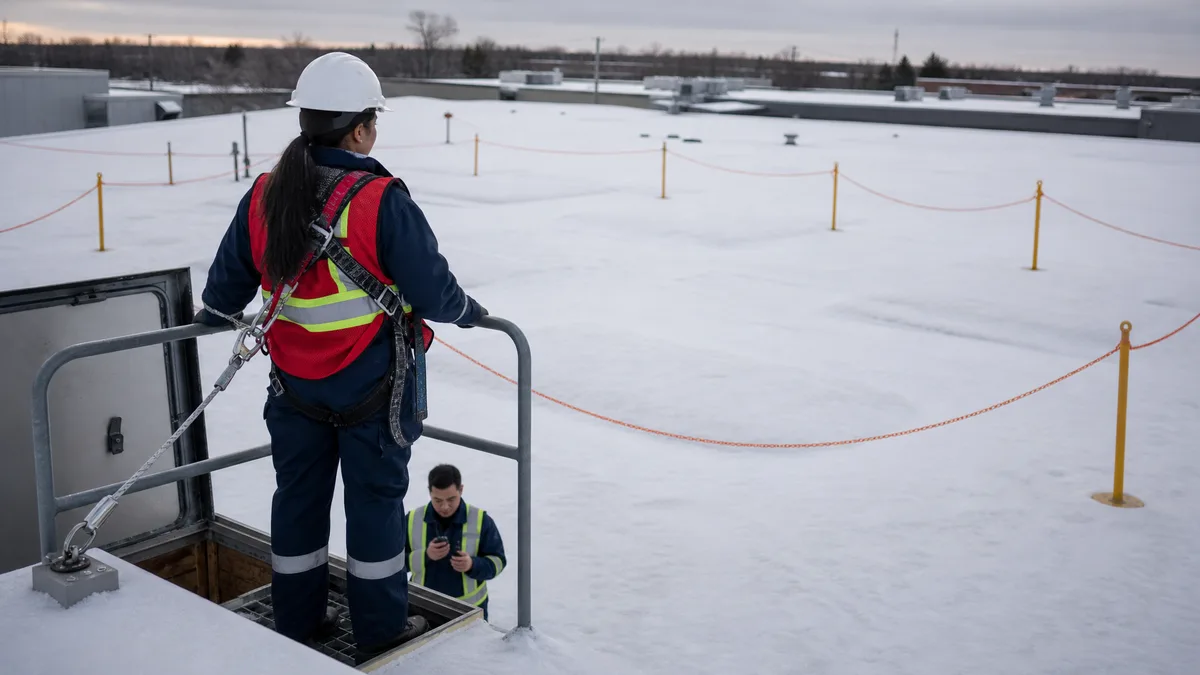
Quebec's CNESST reported a different roof with the same result. A worker was clearing snow off truck trailers from a sliding ladder mounted on a pick-up. When the truck moved with the worker still at the top, the worker fell 3.96 metres and died. CNESST found that the method the employer imposed was itself deficient, that fall protection was used inconsistently through the day, and that supervision did not meet the OHS Act. "On several occasions," the inspectors wrote, "no fall protection or fall arrest device was used to clear snow from the trailers, or when moving the van with the worker on the ladder." The report was covered in December 2025.
If you run a yard or a distribution centre, trailer roofs, dock canopies, rooftop units and mezzanine hatches are the same problem with different geometry. Alberta's Working in Winter bulletin says it in a sentence: snow on rooftops can hide skylights and vents, and frost and ice can destabilize ladders.
Snow hides the skylight and makes the whole roof look the same.
Before anyone goes on a roof
- Know where every skylight, vent and hatch is before the snow falls. A roof plan with them marked is a cheap place to start.
- Ask whether the snow has to come off at all, and if it does, whether it can be done from the ground or with equipment.
- Confirm fall protection and training before access, at your jurisdiction's trigger height. Saskatchewan's is three metres, or any height where a fall could injure. Others set their own.
- Do not start in poor light. Visibility was a factor in the Saskatchewan fatality.
- Check ladder rungs and footing for frost and ice, and never move a vehicle with a person on a ladder attached to it.
- Get your contractor's roof method in writing before the first storm, including who trains and equips the people they send up.
Our fall protection best practices post covers the equipment side, and the Fall Protection Program Template gives you a written program to start from.
What happens when a loader and a pedestrian share the lot?
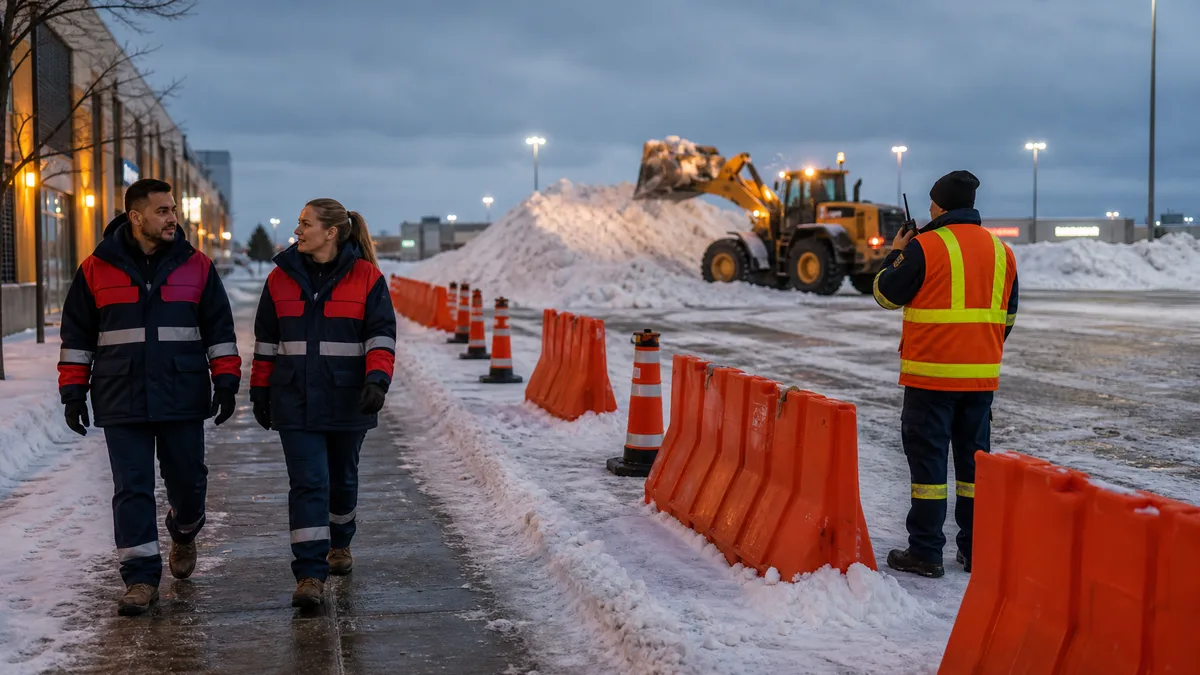
Someone can be crushed by a machine that is only reversing. On February 6, 2023, a 16-year-old grocery worker was collecting carts in a shopping-centre parking lot in Laval, Quebec, while a wheel loader piled snow in another part of the lot. The operator was reversing, and the worker was fatally crushed.
The detail that matters to an owner: this was a lot shared by several parties. The worker was employed by the grocery business whose carts they were collecting, not, as far as the published summary says, by whoever was running the loader. CNESST found that the way worker movement was managed during snow gathering did not prevent collisions between workers and vehicles. The order described in the report went to the worker's own employer, who had to put a method in place that eliminated the risk. The wheel loader was barred from use until it passed a mechanical inspection.
CNESST's recommendations are worth printing. Avoid driving in the lot during snow removal. If you have to drive in it, stay at least 9 metres from the snow removal vehicle. Make eye contact with the operator and be sure they have seen you. Put the phone down and the earbuds away. The shorter version for an owner: keep people out of the lot while equipment is running, and protect and train the ones who can't be.
What a lot-clearing plan should settle
- When the heavy work happens. Piling and hauling belong at times when the lot is closed or nearly empty.
- Where the machine works, marked with barriers or cones, and where pedestrians walk instead.
- Which jobs stay out of the zone while equipment runs: cart collection, deliveries, smoke breaks.
- Who tells the tenants, and how, before the equipment arrives.
- Whether the operator has a spotter when reversing near people.
Struck-By Hazards & Powered Mobile Equipment Awareness
Covers how struck-by incidents happen around mobile equipment, separation of people and machines, and the alarm and visibility measures that reduce the risk. Useful for the staff who work in your lot while the plow is running.
View the Course →Why is carbon monoxide a winter problem on site?
Because closing in the work means adding heat, and fuel-burning heat makes carbon monoxide. In a WorkSafeBC hazard alert, three construction workers needed treatment for CO poisoning after a gas-powered heater was used to warm a building under construction. The heater could run on propane or natural gas, and its valve handle, which was supposed to be locked, slipped from the propane position to the natural gas position. Gas pressure dropped, the propane burned badly, and the exhaust carried more CO than normal. The manufacturer's instructions called for the valve to be locked and, indoors, for exhaust to be vented outside. Neither was done. The workers became dizzy and nauseous.
That alert dates from 2013. We use it because the failure has not aged: a heater, a closed-in space, and a vent that wasn't connected.
Ontario's Ministry of Labour says CO builds up in pockets in poorly ventilated areas "even in semi-enclosed workplaces, where tarps and plastic sheeting are used for shelter." That description fits winter hoarding exactly. The ministry lists heaters, generators, propane equipment, power washers and forklift engines among the sources. In a plant the winter version is the same: dock doors stay shut and the forklifts keep running.
What the rules ask for in Ontario
On an Ontario construction project, O. Reg. 213/91, section 47 says no internal combustion engine may run in a building or enclosed structure without adequate combustion air and either exhaust discharged directly outside or ventilation that stops it building up. Where such an engine runs, the space must be tested for CO by a competent worker under a written testing strategy. Ask whether your heaters fall under that wording or under the general OHSA duty. Exposure limits come from Regulation 833. Other provinces have their own CO limits and heater rules, so check yours before you copy this.
Temporary heat and enclosed work
- Install and use every heater to the manufacturer's instructions, including valve settings and venting.
- Put CO monitors with alarms wherever fuel-burning equipment runs in a closed or tarped space.
- Don't leave equipment running when no one is using it.
- Train the crew on the symptoms: headache, dizziness, nausea, confusion. Anyone with them goes to fresh air and a call to 911.
- Re-check ventilation whenever the enclosure changes, because new tarps and closed doors change the air.
Our Chill Out cold stress course covers the broader winter exposure picture for crews.
Who is accountable when a contractor clears your snow?
You still are, in practical terms. Hiring a contractor changes who holds the shovel and leaves the exposure where it was. In Ontario, the Occupiers' Liability Act names both the occupier and the independent contractor employed to remove snow or ice, and since January 29, 2021 section 6.1 has put a clock on injury claims that starts the day someone falls.
Here is how that clock works, based on the Act and LAWPRO's summary of it. No action can be brought for personal injury caused by snow or ice unless written notice is served within 60 days of the injury. The notice goes to the occupier or the snow contractor, must state the date, time and location, and has to be served personally or by registered mail. Whoever receives it must serve a copy on the other parties, which an internal pass-along does not do. A court can excuse late or defective notice if there is a reasonable excuse and the defendant isn't prejudiced, and the rule doesn't apply if the injured person died. The two-year limitation period still sits on top.
The reason for the rule is evidence. Miller Thomson notes it lets insurers reach witnesses, statements and camera footage while they still exist. So a notice that sits at a front desk for three weeks slows your insurer's access to witnesses and footage, and leaves your snow log as the main thing you can show.
This rule covers premises you occupy. Injuries on municipal roads and sidewalks follow different, shorter notice rules. It is a civil-claim rule and does not replace your duties under the OHSA to your own workers. It does nothing outside Ontario, and it is not legal advice. Talk to your lawyer and your insurer about how it fits your leases and contracts.
What to put in place with a snow contractor
- A written scope: snow depth that triggers a visit, response time, ice treatment, and whether roofs are in or out.
- Their visit and treatment log, and your own inspection log beside it, both kept for the season at least.
- Current proof of workers' compensation coverage and liability insurance, checked again mid-season.
- Their method for roof work and for working around pedestrians, in writing, before the first storm.
- One named person who receives injury notices, a same-day plan to serve copies on the other occupiers and the contractor by personal service or registered mail, with proof of service kept. Record the injury date and work out day 60 from it, not from the day the notice arrived. Ontario sites only.
- A review after the first big storm, while the details are fresh.
When we review winter procedures, the contractor's log is the first thing we ask for. If your safety program already names the person who owns contractor oversight, adding snow to it takes an afternoon.
Where does manual shovelling fit?
Treat it like a lifting job. CCOHS works the arithmetic: a shovel loaded with 5 kg of snow every 5 seconds moves more than 70 kg in a minute and 1,000 kg in 15 minutes. That is hard on the heart and the back, and it is usually done in a hurry, in the cold, by whoever was nearest.
CCOHS recommends shovelling early and often, because fresh, dry snow is lighter than wet, packed or partly melted snow. WCB adds a technique point: push the snow rather than lifting and throwing it. For cold or windy days, use a work and rest schedule, take breaks, and warm up first. Workers with health concerns should talk to their doctor.
The management question is who shovels at your site and whether anyone told them how. If the answer is the receptionist or the first person who happens to be at the door, that is a gap. Our ergonomics post covers the lifting mechanics.
How do you put this in the program before the first snowfall?
As a seasonal addendum with five items, each with an owner. In September we made the case for building seasonal addenda into the safety program so they trigger on the calendar instead of on someone's memory. Winter is the biggest one.
Map your roofs and skylights. Write the 72-hour routine and name who runs it. Put the lot-clearing plan and the roof method into the snow contract. Set the rule for temporary heat. Tell your shovelling crew how to do it. Then run it once on the first storm and fix what didn't work.
The timing data we rely on is one province's, and the fatality cases are a handful of incidents, not a rate. They are useful because each one shows a specific control that was missing, and each missing control is cheap compared with the outcome.
Sources
- WCB Nova Scotia — Winter workplace injuries accumulating, WCB data shows (February 2026)
- WCB Nova Scotia — Media backgrounder: winter workplace injuries in Nova Scotia
- WorkSafe Saskatchewan — Workplace Fatality Summary Report: Worker Fatally Injured Falling Through a Skylight
- Canadian Occupational Safety — Employer fined $325,000 for workplace fatality, injury (May 2024)
- Canadian Occupational Safety — Unsafe work methods led to fatal fall of Quebec roof snow remover: CNESST (December 2025)
- Canadian Occupational Safety — Report into teen worker killed during snow removal (CNESST, February 2024)
- WorkSafeBC — Hazard Alert: Workers poisoned by carbon monoxide while using heater (July 2013)
- Ontario Ministry of Labour — Carbon monoxide poisoning in workplaces
- IHSA — Carbon Monoxide (O. Reg. 213/91, s. 47)
- Government of Alberta — Working in winter (GS014)
- Province of Ontario — Occupiers' Liability Act, R.S.O. 1990, c. O.2, s. 6.1
- LAWPRO — New 60 Day Notice Requirement in Occupiers' Liability Act (Injury from Snow or Ice)
- Miller Thomson — Bill 118: Changes to the notice period for slip and fall claims in Ontario
- CCOHS — Shovelling - Snow