Working in Wildfire Smoke: Air Quality Tools and Respirator Rules for Canadian Crews

On July 16 this year, Milwaukee recorded an air quality index of 644. The city's previous record was 300, set in 1987, and 500 is the published ceiling of the EPA's scale. The smoke came from Canada.
By mid-July more than 800 fires were burning across the country, roughly 1.9 million hectares had gone up since January, and over 100 million people across North America sat under air quality advisories at the peak of the event. If you run outdoor crews, none of that is a weather story. It is an exposure problem, and it arrives with a paper trail.
Smoke is the one hazard on your site that shows up without a work order, changes hourly, and is legible to everyone including an inspector.
How bad is the 2026 season compared to a normal year?
Bad, though not record-breaking. Forecasters expect 2026 to land as a heavy fire year without dethroning 2023, which remains the benchmark for the worst season on record. That framing matters because it sets the wrong expectation for employers. A season that is merely severe still produces multi-day AQHI 10+ events over major population centres, and those are the days your crews are outside in it.
The pattern that has settled in over the last few seasons is smoke travelling much further than the fire. Ontario fires drove air quality alerts into 18 U.S. states this July, from Minnesota to Virginia. A crew in southern Ontario or the Prairies can be a thousand kilometres from any active fire and still be working in the worst air of the year. Distance from the flame is not a control.
The other change is duration. A smoke event used to mean an afternoon. Increasingly it means a stretch of days where the AQHI never drops back into the low range, which turns a nuisance into a cumulative exposure question and makes the disposable-respirator arithmetic in your budget suddenly real.
What wildfire smoke does to a working body
The health risk is carried mostly by fine particulate matter, PM2.5, which measures 2.5 micrometres or less. That is roughly thirty times smaller than the width of a human hair, small enough to travel past the upper airway, deposit deep in the lungs, and cross into the bloodstream. Environment and Climate Change Canada switches the AQHI calculation to PM2.5 alone during smoke events precisely because it swamps the other pollutants in the index.
Short-term exposure is linked to increased respiratory illness and excess mortality. Long-term exposure to smoke-derived PM2.5 has been associated with all-cause mortality, with cardiovascular disease accounting for the largest share. Modelling published in 2024 put the toll at more than 11,000 non-accidental deaths per year across the contiguous United States from smoke PM2.5 alone.
For workers there is a multiplier that the public health messaging misses. A worker doing heavy manual labour moves several times the air volume of someone sitting indoors, breathes more of it through the mouth rather than the nose, and does it for eight to twelve hours. The same ambient concentration delivers a much larger dose. Two crews standing in the same AQHI 8 air are not receiving the same exposure if one of them is swinging a hammer.
Smoke does not travel alone in August
Wildfire smoke events cluster with heat events, because the same blocking high-pressure systems that park smoke over a region also drive temperatures up. Respirators add breathing resistance and trap heat against the face, which compounds heat strain in workers already near their limit. If you are adding respiratory protection during a heat wave, revisit your work-rest cycles at the same time. Our Heat Stress Awareness course covers the interaction.
Where to check air quality before you send a crew out
Deciding whether to work is a data problem, and the data is free. What follows is what we actually recommend clients bookmark, grouped by the question each one answers.
The health-risk number your decisions hang on
- Environment Canada AQHI — the official Canadian index, 1 to 10+, updated hourly and switched to PM2.5-only during smoke events. This is the number to write into your exposure control plan, because it is the one a regulator will recognize.
- WeatherCAN — ECCC's own app, with AQHI alerts you can push to a phone. Useful for supervisors who need the alert rather than the dashboard.
Knowing what the air will be like tomorrow
- FireSmoke.ca — the BlueSky Canada smoke forecasting system out of UBC. Hourly, daily-average, and daily-maximum ground-level PM2.5 forecasts out to about two days, published April through September. This is the single most useful planning tool on the list, because it lets you move concrete pours and roofing work before the smoke arrives rather than after.
- AirNow Fire and Smoke Map — US EPA, but it renders the cross-border plume better than most Canadian tools and blends regulatory monitors with low-cost sensors.
- Windy — turn on the PM2.5 layer. Worth having for the wind-direction picture, which tells you whether tomorrow gets better or worse.
Where the fires actually are
- Canadian Wildland Fire Information System (CWFIS) — Natural Resources Canada's national map of active fires, fire weather, and fire danger ratings.
- NASA FIRMS — satellite hotspot detections, refreshed within hours. This is what to check when a client asks whether a fire is near a remote site.
- Provincial dashboards: BC Wildfire Service, Alberta Wildfire Status, Ontario Forest Fire Information Map, and the equivalents in Saskatchewan, Manitoba, and Quebec. These carry evacuation orders and highway closures, which matter for site access and crew travel.
Hyper-local readings when the nearest official monitor is far away
- PurpleAir — a dense network of crowd-sourced sensors. Individual sensors are less accurate than regulatory monitors and tend to read high in smoke, but when the closest government station is 80 kilometres away, a nearby PurpleAir sensor tells you more about your site than the official number does.
- IQAir — blends monitors and sensors into a single map, with a usable mobile app.
- AccuWeather Air Quality — pairs an air quality forecast with the standard weather forecast in one view, which is the format most supervisors will actually check at 6 a.m.
- WildfireSmoke.ca — a Canadian-focused live PM2.5 and AQHI view built specifically around smoke events.
Do not use visibility as your gauge
Crews routinely judge smoke by how far they can see, and it is not a reliable proxy. Visibility reduction tracks particle size and humidity as much as concentration, so a day that looks merely hazy can carry a higher PM2.5 load than one that looks dramatic. Pick a number from a named source, and make that the trigger. "It doesn't look too bad today" is not a control measure and reads badly in an incident file.
What should the AQHI number actually change on your site?
No Canadian jurisdiction publishes a hard number that stops outdoor work. Alberta OHS, WorkSafeBC, and Ontario's Ministry of Labour all route this through the general duty clause instead: identify the hazard, control it as far as is reasonably practicable, document what you did. WorkSafeBC has been the most direct, telling employers to eliminate smoke exposure where possible, and where it is not, to use the AQHI when scheduling outdoor work and determining what PPE is required.
That leaves the threshold to you, which is an opportunity rather than a gap. Write it down before the season and you get a decision that does not need re-litigating with a foreman on a Tuesday morning. Leave it undefined and every smoke day becomes a negotiation between a schedule and a supervisor's judgement, which is a fight the schedule usually wins.
Here is a structure that has held up well with our construction and utility clients. Adapt the numbers to your work, but keep the shape.
A workable AQHI trigger framework
- AQHI 1–3 (Low): Normal operations. Nothing required.
- AQHI 4–6 (Moderate): Supervisor checks the index at start of shift and mid-shift. Brief the crew. Workers with asthma, COPD, or cardiovascular conditions self-identify and get lighter duties. Respirators made available on request.
- AQHI 7–10 (High): Reschedule strenuous work to the cleanest hours or to another day. Extend rest breaks and take them in filtered air. Offer fit-tested respirators to everyone remaining outdoors. Increase water. Reassess hourly, since smoke can shift fast.
- AQHI above 10 (Very high): Stop non-essential outdoor work. Move crews to indoor tasks with HEPA filtration or to a cleaner area. Essential outdoor work proceeds only with respiratory protection under a full written program and a documented reason.
- Any level: A worker reporting chest tightness, wheezing, dizziness, or unusual shortness of breath comes out of the smoke immediately, regardless of the number on the screen.
One point that gets skipped in the planning: workers in Canada have the right to refuse work they reasonably believe is unsafe, and smoke is not carved out of that. A crew that has been briefed on your thresholds and can see you applying them rarely needs to exercise it. A crew that has been told to just get on with it sometimes does, and the resulting investigation is more expensive than the lost afternoon would have been.
Write the threshold down before the season and you get a decision. Leave it undefined and every smoke day becomes a negotiation between a schedule and a supervisor's judgement.
Does an N95 actually help against wildfire smoke?
For the particles, yes, and the effect is substantial. A NIOSH-approved N95 filters at least 95 percent of airborne particles at the most-penetrating size, which is the hardest test case, not the easiest. Worn properly on a clean-shaven face with a passing fit test, it cuts particle exposure by roughly a factor of ten.
What it will not do is filter gases, and wildfire smoke is not only particles. Carbon monoxide, ozone, acrolein, formaldehyde, and a long list of volatile organic compounds pass straight through the filter media. That limitation is the reason a respirator sits at the bottom of the hierarchy of controls and not the top. Handing out N95s is what you do after you have already tried to move the work to a cleaner day, put the crew somewhere with filtered air, or take the heavy exertion out of the shift.
It also rules out the equipment most people reach for first. Surgical masks, cloth masks, and bandanas do essentially nothing against PM2.5 because they neither filter at that size nor seal to the face. If a worker is going to wear something, it needs to be a NIOSH-approved respirator or it is theatre.
One nuance worth knowing: an exhalation valve is fine here. Valves are restricted in infection-control settings because they vent unfiltered breath outward, but for smoke that is irrelevant, and the valve makes a long shift noticeably more tolerable.
Respiratory Protection Awareness
Covers respirator selection, the limits of filtering facepieces, fit testing and seal checks, cartridge selection, medical clearance, and the maintenance and storage rules that keep a respirator working. Built to CSA Z94.4 and suitable for crews facing smoke, dust, and chemical exposures.
View the Course →The three things that decide whether your N95 works
A respirator that does not seal is a comfort item. Three requirements separate protection from the appearance of it, and in our experience the second and third are where most programs come apart.
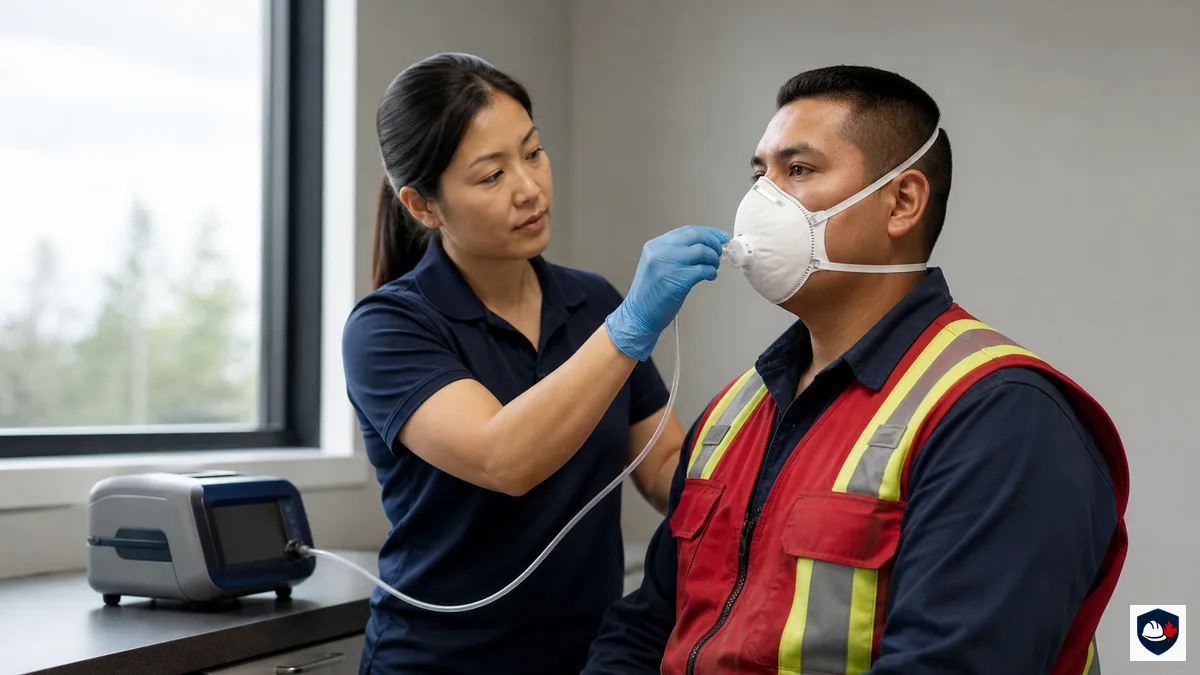
Clean-shaven, every shift. Every tight-fitting respirator seals against skin, and facial hair crossing the sealing surface breaks that seal without announcing itself. CSA Z94.4-18 (R2023) requires workers to be clean-shaven where hair would interfere with the seal, and recommends shaving within 12 to 24 hours of wearing the respirator. Not last week. A day or two of stubble is enough to drop fit factor measurably, and a full beard makes the fit test meaningless.
This is the rule that generates the most pushback, so be ready with the alternative rather than the argument. A loose-fitting powered air-purifying respirator (PAPR) supplies filtered air under positive pressure and does not depend on a face seal, which makes it the correct answer for a worker who cannot shave for religious or medical reasons, or who simply will not. PAPRs cost more. They cost considerably less than a contested exposure claim.
Fit tested, with the test on file. CSA Z94.4 requires fit testing at least every two years for tight-fitting respirators, and sooner if anything changes the shape of the face: significant weight change, major dental work, facial surgery or scarring. Faces differ enough that a model fitting one worker perfectly can fail on the next, which is why you stock two or three models rather than one.
Fit testing is not the same as a seal check, and the two get conflated constantly. The fit test is a formal, supervised procedure done once and documented. The seal check is what the worker performs every single time they put the respirator on: cover the facepiece, inhale gently, feel for the mask drawing slightly inward without air leaking around the edges. Teach both, and audit the second one, because it is the one that quietly stops happening in week three of a smoke event.
Replaced on condition, not on a schedule. There is no clean answer to "how many hours does an N95 last," because it depends on how thick the smoke is and how hard the worker is breathing. Published guidance spans 8 to 40 hours of use, a range broad enough to be useless as a rule. Go by condition instead.
Discard an N95 as soon as any of these is true
- Breathing through it has become noticeably harder — the filter media has loaded
- It is damp, from sweat or exhaled moisture
- It is visibly soiled, crushed, or deformed out of shape
- The straps have stretched and no longer hold tension
- The nose clip will not hold its form against the bridge of the nose
- The worker cannot pass a seal check
In practice, budget at least one respirator per worker per shift during a sustained smoke event, and more when workers are exerting themselves or the AQHI sits above 7. If a respirator is being reused between shifts it should be stored dry in a breathable paper bag rather than a plastic one, which traps moisture and degrades the media. Running out of stock mid-week is what turns a functioning program into a reused, sweat-soaked respirator on day four, and that is worse than no program at all because everyone believes they are protected.
When should you move up from an N95?
Disposables make sense for intermittent exposure. Once smoke becomes a multi-week condition rather than a bad afternoon, a reusable half-face elastomeric respirator with P100 filters is usually the better call, on both protection and cost.
P100 filters capture at least 99.97 percent of particles, against 95 percent for an N95. The facepiece seals more reliably and more repeatably, survives being knocked around a truck, and can be cleaned and reused across a whole season. Filter cartridges get swapped rather than the entire unit. For ash and debris cleanup after a fire, where the particle load is far heavier than in ambient smoke, a half-face P100 should be the default rather than the upgrade.
Half-face elastomerics also open the door to combination cartridges. A P100 filter paired with an organic vapour and acid gas cartridge addresses some of the gas fraction that no particulate filter touches. Worth knowing where that stops: nothing in the air-purifying category removes carbon monoxide. Not an N95, not a P100, not an OV/AG cartridge. Carbon monoxide is what kills people in structure fires, and the only protection against it is supplied air or getting out. If your crews are working close enough to active fire that CO is a live concern, respirator selection is no longer the conversation you should be having.
Required use triggers the full program
There is a meaningful legal difference between making respirators available and requiring them. Once your employer requires respiratory protection, CSA Z94.4 and provincial OHS regulation bring the whole program with it: a written respiratory protection code of practice, a documented hazard assessment, justified selection, medical clearance for the worker, fit testing, training, seal checks, and maintenance and storage records. Handing out a box of N95s at the gate without any of that is the version we most often find during audits, and it does not hold up.
How to build smoke into your program before the next flare-up
Most employers we work with treat wildfire smoke as an interruption and manage it improvisationally, every season. The fix is small and it is mostly paperwork done in advance.
Add smoke as a named hazard in your hazard assessment, alongside heat and cold. Write the AQHI thresholds into an exposure control plan and name the source you will check. Decide now, not in August, what respirators you stock and in how many sizes. Get your outdoor crews fit tested in the spring, when a fit tester can still be booked inside a week rather than a month. Confirm which workers have asthma, COPD, or cardiac conditions, and what alternative duties they move to. Put a HEPA filtration unit in the site trailer so that "take a break in clean air" is an instruction rather than an aspiration.
Then brief it. A ten-minute toolbox talk before the season that covers what the AQHI means, where to look it up, how to seal-check a respirator, and when to shave, will outperform any amount of policy that lives only in a binder. Fold smoke into your emergency response planning while you are there, because the same events that produce the smoke also produce evacuation orders and highway closures that strand crews.
The employers who handle smoke well are not the ones with better equipment. They are the ones who decided in April what they would do in August.
One honest caveat. The research on chronic occupational exposure to wildfire smoke in non-firefighting workers is thin. We have solid data on wildland firefighters and solid data on the general public, and a real gap in the middle where road crews, roofers, landscapers, and utility workers sit. Anyone telling you exactly what a decade of summers at AQHI 8 does to a framer is guessing. That uncertainty argues for controlling exposure now rather than waiting for the study, and it is the same argument the industry eventually accepted about silica and diesel exhaust.
Sources
- Environment and Climate Change Canada — Wildfire smoke, air quality and your health
- Health Canada — Wildfire smoke and your health
- CCOHS — Respirator Fit Testing
- CSA Group — CAN/CSA-Z94.4-18 (R2023), Selection, use, and care of respirators
- NIOSH / CDC — How to Protect Workers and the Public from Wildfire Smoke
- WorkSafeBC — Employer guidance on summer weather hazards and smoke exposure
- Alberta OHS — Wildfire smoke: OHS information for employers and workers (FI007)
- BlueSky Canada / UBC — FireSmoke.ca smoke forecast methodology
- US EPA — Protect Yourself From Wildfire Smoke and Ash
- CBC News — Tracking the 2026 wildfires in Canada